
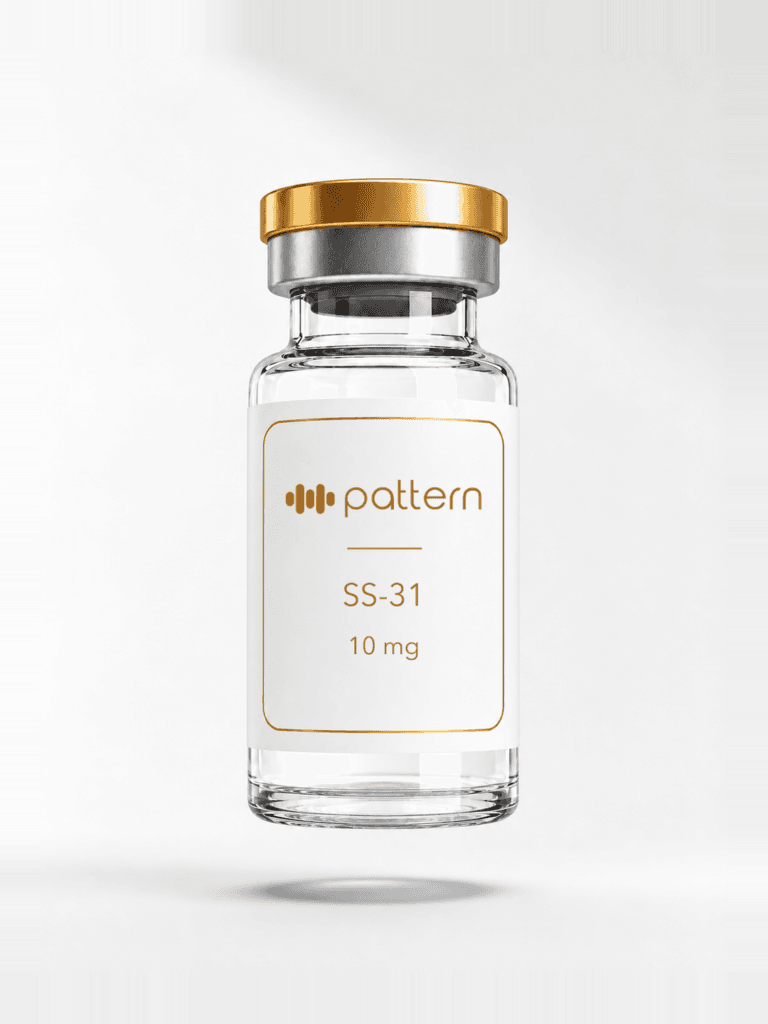
SS-31
Overview
Research-use mitochondria-targeting tetrapeptide supplied for studies of cardiolipin interactions, mitochondrial bioenergetics, and oxidative-stress models.
- Concentration
- 10 mg / 50 mg
- Stock
- In stock
Product details
SS-31 is a mitochondria-targeting tetrapeptide used in research models of cardiolipin interactions and mitochondrial bioenergetics. Pattern lists this material for controlled laboratory research.
Research Targets: Inner mitochondrial membrane systems, cardiolipin interaction models, electron transport chain pathway markers.
Key Feature: Cationic aromatic tetrapeptide format for mitochondrial pathway research.
Research Focus Areas: Mitochondrial bioenergetics, oxidative-stress models, membrane organization, cardiac and metabolic pathway studies.
Common Models: Isolated mitochondria assays, cell-based energy-deficit models, oxidative-stress experiments.
Mechanistic Interests: Cardiolipin binding models, electron transport chain efficiency markers, mitochondrial membrane potential, ROS pathway response.
Use Boundary: Research use only; not for human or veterinary use; no diagnostic, therapeutic, or consumption use is implied.
Product documentation
Certificate of Analysis
SS-31
Review the public certificate available for this product before creating an account or checking out.
Research context
Peptide guide
Open full guide- Guide profile
- Elamipretide / MTP-131 / Bendavia
- Composition
- Synthetic, cell-permeable tetrapeptide (D-Arg-Dmt-Lys-Phe-NH2) designed to selectively target the inner mitochondrial membrane
- Discovery
- Developed in the early 2000s by researchers, including Dr. Hazel Szeto, at Weill Cornell Medicine, focusing on mitochondria-penetrating peptides to address oxidative stress
- Research scope
- Preclinical models (cells, rodents) demonstrate SS-31's ability to restore mitochondrial respiration, enhance ATP synthesis, reduce ROS, improve mitochondrial morphology, and protect tissues in heart failure, Barth syndrome, primary mitochondrial myopathy, neurodegeneration, and ischemia
- Regulatory status
- FDA-approved for Barth syndrome; investigational for most other uses
Safety context
- Limited long-term data outside approved use (Barth syndrome)
- Potential risks (e.g., unknown prolonged effects) are not fully characterized
- Remains investigational for most uses beyond FDA approval
Research-use notice: SS-31/elamipretide has FDA accelerated approval for Barth syndrome as Forzinity, but most other uses remain investigational. Human evidence varies by indication, and long-term data outside approved use are limited. Potential risks are not fully characterized for off-label longevity, recovery, or regenerative claims, so clinical decisions require qualified medical oversight.
Full guide includes 10 reference entries.

